|
|
On the afternoon of March 5, 2026, at the invitation of our school, Wu Yaping—a researcher at the Investment Research Institute of the National Development and Reform Commission and a professor in the Department of Investment Economics at the University of Chinese Academy of Social Sciences—visited our school to deliver an academic lecture titled “Approaches and Priorities for Expanding Effective Investment During the 15th Five-Year Plan Period.” The lecture was chaired by Peng Jiquan, Vice Dean of the School.
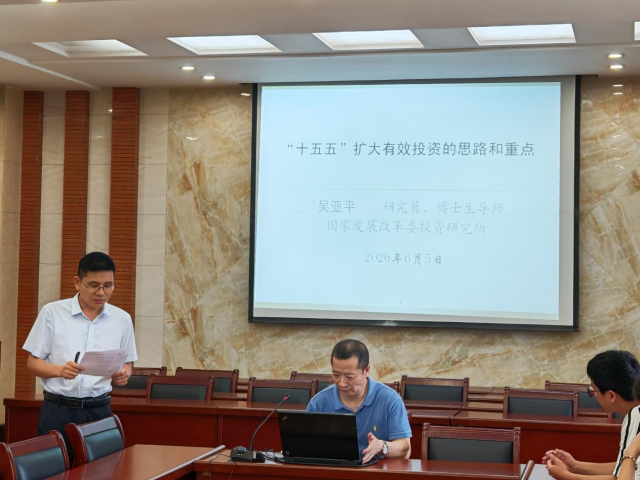
At the outset of the lecture, Wu Yaping began by examining the domestic and international development environment during the “15th Five-Year Plan” period, offering a profound analysis of the opportunities and challenges China faces in expanding effective investment amid a period of profound change unseen in a century. He pointed out that the “15th Five-Year Plan” period is a strategic decisive phase for laying a solid foundation and making a comprehensive push toward basically achieving socialist modernization. It is essential to coordinate six major relationships—including balancing development and security, and enhancing quality while expanding total volume—to drive high-quality development through investment that is “demand-driven and profitable.” Through an in-depth analysis of four major shortcomings currently present in the investment sector—namely, a “lack of projects with good returns,” a “lack of investment entities with good creditworthiness,” a “lack of suitable investment and financing models,” and a “lack of suitable financial instruments”—he systematically elaborated on the overall approach to expanding effective investment: expanding investment scope and improving investment efficiency, while striving to achieve the two major objectives of maintaining reasonable investment growth and enhancing the comprehensive benefits of investment. Wu Yaping emphasized that the future investment structure must accelerate its strategic transformation toward four key directions: promoting growth in consumer demand, improving the quality of existing asset supply, fostering new growth drivers and emerging sectors, and jointly building the “Belt and Road” Initiative to high standards. In cultivating new-quality productive forces, the focus should be on achieving high-level self-reliance and strength in science and technology and establishing a modern industrial system, while promoting the deep integration of scientific and technological innovation with industrial innovation and the digital economy with the real economy. Priority should be given to building scientific and technological innovation capabilities, optimizing and upgrading traditional industries, and strategically positioning emerging industries. He specifically pointed out the need to comprehensively strengthen “soft infrastructure”—refining planning policies, institutional mechanisms, and technical standards at the national level, while at the project level improving investment and financing mechanisms, strengthening the allocation of resources and factors of production, and optimizing construction and operation models—so that high-level “soft infrastructure” can drive the implementation and effectiveness of high-quality “hard investment.” Finally, during the Q&A session, in response to questions raised by faculty and students regarding the prevention of local government debt risks, pathways for private capital participation under the new mechanism, and the development prospects of publicly offered infrastructure funds, Wu Yaping provided detailed answers to each question, drawing on his extensive experience participating in major national research projects and engineering initiatives. He encouraged the students to ground their work in China’s national conditions, pay close attention to reality, and closely integrate theoretical research with national strategic needs. Amid a vibrant academic atmosphere, the lecture concluded successfully. School websit link://qnwallet.com.cn/news-show-7026.html Translated by Ying Liu
|
|


